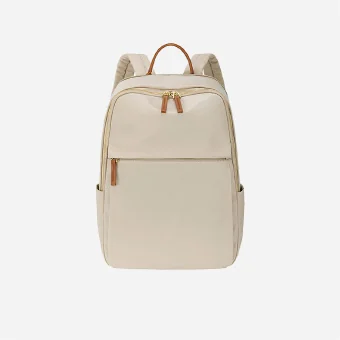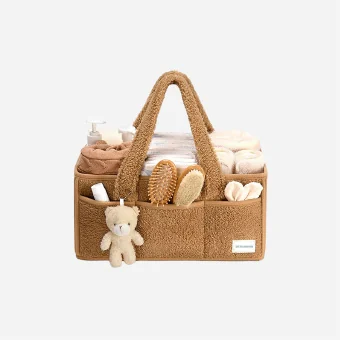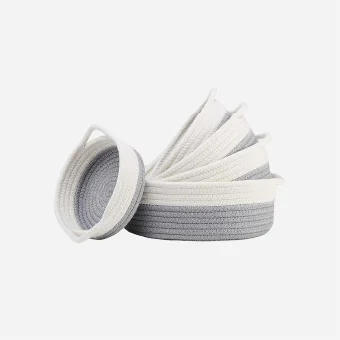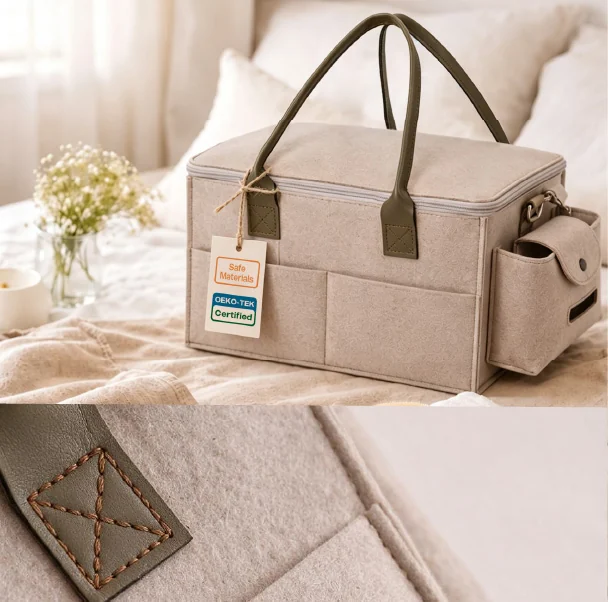
Material safety is no longer a final inspection item for baby-care accessories. For brands sourcing mommy bags, diaper caddies and custom nursery storage, it should shape the product brief, supplier selection, component approval and testing plan from day one. This guide explains how OEKO-TEX® STANDARD 100, EU REACH obligations and U.S. children’s product rules fit into a practical sourcing workflow.
Why material safety matters before sampling
A mommy bag may look like a general-use fashion accessory, while a diaper caddy may be marketed as nursery storage. Yet the same product can be assessed differently when its labeling, design details or intended users change. Printed coatings, zipper pulls, plastic buckles, foam reinforcement, water-resistant treatments and decorative patches can all introduce separate material questions. Waiting until a finished sample is ready to define the testing scope can create expensive redesigns and missed delivery dates.
A reliable OEM diaper bag manufacturer should therefore begin with a market-and-use review, not only a price quotation. The brand should identify where the product will be sold, whether it is intended primarily for adults or children, how it will be described online and on packaging, and which parts are accessible during normal use. These decisions help a laboratory determine which rules and test methods apply.
What OEKO-TEX STANDARD 100 tells a buyer
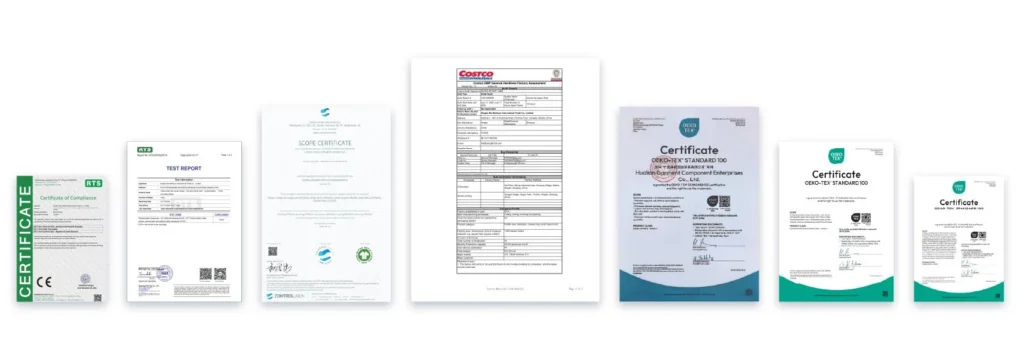
OEKO-TEX® STANDARD 100 is a voluntary certification for textiles tested for harmful substances. According to OEKO-TEX, certification can cover the complete article as well as components such as fabrics, threads, buttons and accessories. Testing becomes stricter as skin contact increases and the user becomes more sensitive. Product Class I, intended for babies and children up to three years, has the strictest requirements.
For a diaper bag or fabric caddy, an OEKO-TEX certificate can be valuable evidence that a certified material or article has been evaluated against the applicable STANDARD 100 criteria. It is not, however, a substitute for every legal requirement in every market. Buyers should check the certificate number, scope, product class, named certificate holder, covered materials and validity period. A fabric certificate does not automatically prove that an entire finished bag – including coatings, prints, foam, hardware and labels – is certified.
REACH explained for bags and nursery storage
REACH is the European Union framework for the registration, evaluation, authorisation and restriction of chemicals. Finished bags, caddies and organizers are generally treated as “articles” because their shape and design determine their function more than their chemical composition. For buyers, two practical areas deserve attention: restrictions under REACH Annex XVII and obligations connected to Substances of Very High Concern on the ECHA Candidate List.
ECHA explains that suppliers of an article containing a Candidate List substance above 0.1% weight by weight must provide enough information to professional recipients for safe use, with at least the substance name. Notification duties can also apply to EU producers and importers when additional quantity and exposure conditions are met. Because the Candidate List changes over time, a report from an old collection should not be assumed to cover a new season, a new color or a changed component.
This is why traceable component information matters. A test report should identify the exact sample, color, material composition, test method, date and applicant. When a custom nursery storage program changes from uncoated cotton to a coated polyester lining, the change should trigger a compliance review even if the outside dimensions and visual design remain the same.
Build a market-specific testing checklist
There is no single “global baby product certificate” that replaces a market-specific assessment. In the United States, the Consumer Product Safety Improvement Act addresses matters including lead, phthalates, third-party testing and certification for covered children’s products. CPSC guidance also makes clear that requirements depend on the product’s intended use, age group and accessible materials. In the EU, REACH chemical requirements sit alongside other product-specific and general safety obligations.
| Component | Questions to ask | Useful evidence |
|---|---|---|
| Outer fabric and lining | Fiber content, dyeing method, coating, color and skin-contact scenario | Material specification, valid certificate, color-specific test report |
| Prints and labels | Ink chemistry, surface coating, wash durability and accessibility | Ink declaration, supplier data, finished-component test |
| Buckles and zipper parts | Plasticizer use, metal composition, finish and accessible surfaces | Component report, bill of materials, approved supplier record |
| Foam and reinforcement | Composition, adhesive system, odor and migration risk | Safety data, material declaration and risk-based testing |
| Packaging | Is it disposable, reusable or part of the product experience? | Packaging specification, print and material compliance review |
Documents to request from an OEM supplier
Before approving bulk production, create a document pack linked to the approved sample and bill of materials. At minimum, request material specifications, color references, component supplier records, relevant certificates, recent test reports and a signed statement describing any material substitutions. Reports should come from competent laboratories and clearly identify what was tested. A vague PDF for “polyester fabric” should not be treated as evidence for every polyester used by the factory.
Strong document control also improves repeat orders. If a brand returns six months later for a new color of the same mommy bag, the team can identify which parts remain unchanged, which reports are still relevant and which colored or coated materials require new evaluation. This is one of the practical differences between a transactional supplier and an experienced OEM diaper bag manufacturer.
Material planning for custom nursery storage
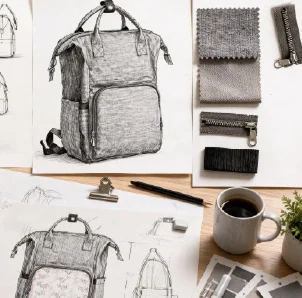
Custom caddies and baskets often combine more materials than buyers expect: sherpa or felt panels, cotton rope, nonwoven reinforcement, removable dividers, handles, printed labels and packaging. Begin with the intended care routine. Will the caddy sit beside a changing table, travel between rooms or be used as a reusable gift basket? Will parents frequently touch the lining? Could a baby reach decorative parts? The answers influence construction choices and the test plan.
For a custom nursery storage range, standardize safe, documented components across several SKUs whenever possible. The same approved lining, label system and handle construction can reduce unnecessary variation while keeping the collection visually coordinated. Standardization does not eliminate testing, but it improves traceability and makes change control easier.
How to evaluate an OEM diaper bag manufacturer
Ask prospective suppliers to explain their compliance workflow in concrete steps. Who reviews the product brief? How are material lots linked to purchase orders? What happens when a supplier changes a coating or zipper finish? Can the factory provide certificate scopes and original laboratory reports rather than screenshots? How are approved samples sealed and stored? A capable OEM diaper bag manufacturer should be able to answer without promising that one certificate covers everything.
The best sourcing conversation connects safety, performance and commercial goals. A lighter fabric may reduce cost and shipping weight, but it may also require different reinforcement. A waterproof coating may improve cleaning, but it adds chemical and durability questions. The right decision balances intended use, target price, test scope, brand positioning and production repeatability.
A practical pre-production action plan
- Define the destination markets, intended user, age positioning and product claims.
- Create a component-level bill of materials for every fabric, coating, trim and label.
- Map applicable legal requirements and voluntary certifications with specialists.
- Review certificate scope and validity instead of accepting a logo at face value.
- Approve representative samples and agree on any color-specific testing needs.
- Freeze materials before bulk production and document every approved change.
- Keep reports, certificates and production records linked to the final SKU.
Following this sequence helps brands develop safer, more consistent products without treating compliance as a last-minute paperwork exercise. It also gives procurement, design, quality and marketing teams one shared record for each diaper bag or custom nursery storage item.